







News > News
07.07.26
At Energy Summit, IIS Executive Director highlights the potential of biochar and Nature-based Solutions
At Energy Summit, IIS Executive Director highlights the potential of biochar and Nature-based Solutions
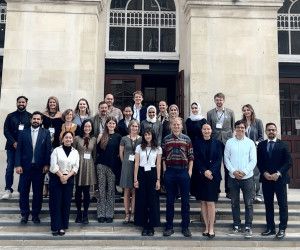
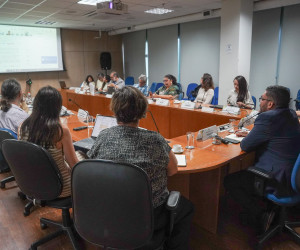
IIS Executive Director Agnieszka Latawiec took part as a speaker at the Energy Summit, an annual event held in Rio de Janeiro that brings together researchers, businesses, investors, policymakers and representatives from the productive sector to discuss innovation, the energy transition and decarbonisation solutions. During the panel “Nature-based Solutions: Evidence, Metrics and Trade-offs”, she presented research conducted by IIS on the potential of Nature-based Solutions (NbS), with a particular focus on biochar.
“The answer lies beneath our feet, more specifically in our pastures and in ecological restoration at scale,” she said, highlighting that Brazil has favourable conditions to expand the use of biochar, particularly in these landscapes.
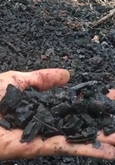
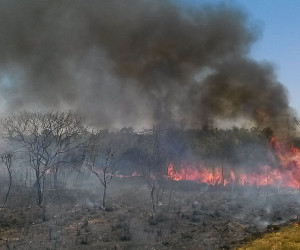
Produced through the pyrolysis of biomass under low-oxygen conditions, biochar is a carbon-rich material that acts as a long-term carbon reservoir when incorporated into soil. In addition to contributing to carbon sequestration, it can improve the soil’s physical and biological properties, including water retention and microbial activity.
She noted that IIS has been investigating the impacts of biochar application in pasture management since 2011. The studies have demonstrated increases in soil carbon stocks, greater biomass production and improved forage quality. Higher productivity per hectare can also reduce pressure for agricultural expansion, creating opportunities to increase forest restoration.
“Turning pasturelands from emission sources into permanent carbon sinks is one of the greatest opportunities for Nature-based Solutions today.”
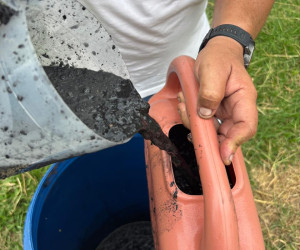
Another IIS research line evaluates the use of biochar in ecological restoration projects. Results indicate that incorporating biochar into soils and seedling substrates can improve the survival and early establishment of native seedlings, accelerating the removal of carbon dioxide from the atmosphere while supporting the long-term retention of carbon throughout the restoration process.
During the discussion, Agnieszka also addressed one of the main challenges to scaling up Nature-based Solutions: ensuring that outcomes can be measured rigorously and maintained over time.
Restoring ecological functions is key
According to her, assessment should not focus solely on the amount of carbon stored, but also on the recovery of ecosystem functions.
“The key to maximising the success and integrity of large-scale restoration lies in selecting the right combination of metrics. Rather than focusing only on stored carbon, we need to assess which ecological functions have been effectively restored and which processes indicate a lasting systemic response.”
Regarding soils, Agnieszka explained that recent research shows that measuring only soil organic carbon stocks is insufficient to assess carbon permanence. She argued that monitoring should also include indicators related to carbon fractions, soil biochemical processes, soil biodiversity, water resources and socioeconomic impacts, generating robust and auditable data.
She also highlighted that advances in remote sensing, artificial intelligence, spatial modelling and emerging monitoring techniques have significantly expanded the capacity to track these changes at scale.
“Science provides the rigour needed to calibrate interventions and ensure that scaling up translates into long-term ecological permanence.”