







Publications > Blog
From Five Stars to the Decade of Restoration: How the Environmental Agenda Evolved Across Brazil’s World Cup Victories
*Carolina Mazzi and Luiz Conrado Silva
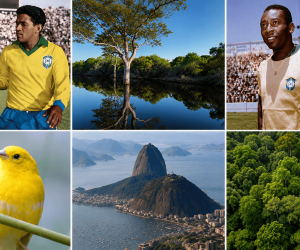
When Pelé lifted his first World Cup trophy for Brazil in 1958, concepts such as climate change, ecosystem services, Nature-based Solutions (NbS), and ecological restoration were not yet part of the scientific or political vocabulary. At that time, science was just beginning to understand the impact of human activities on the planet, while nature conservation remained on the periphery of major global decisions.
At that time, science was only beginning to understand the impacts of human activities on the planet, while nature conservation remained largely on the periphery of global decision-making.
Since then, Brazil has built one of the greatest legacies in world football, winning five World Cup titles and lifting the trophy in nearly every subsequent decade, with the exception of the 1980s. Interestingly, the history of the Brazilian national team offers a compelling opportunity to revisit the evolution of the global environmental agenda, as each championship roughly coincides with key milestones in environmental science and policy.
Over the past 70 years, issues such as pollution, global warming, biodiversity conservation, and sustainable development have assumed an increasingly prominent place in scientific research and international negotiations. This agenda did not emerge overnight; rather, it evolved gradually through scientific discoveries, political negotiations, and growing public awareness. Today, the triple planetary crisis—climate change, biodiversity loss, and land degradation—is recognized worldwide, and ecological restoration has emerged as one of the most important strategies for addressing these interconnected challenges while delivering multiple environmental and social benefits.
As an observer organization at United Nations conferences, the IIS closely follows these developments and contributes to advancing this agenda through scientific publications, technical reports, and innovative solutions that integrate territorial planning, ecological modeling, and Nature-based Solutions.
By tracing the history of the Brazilian national football team alongside the evolution of the global environmental agenda, we can see how science, much like football, has the power to mobilize people, inspire transformation, and build lasting legacies.
1958: Science Begins to Understand the Problem
When Brazil won its first World Cup in Sweden, modern climate science was still in its infancy.
In 1957, researchers Roger Revelle and Hans Suess published a landmark study (REVELLE; SUESS, 1957) demonstrating that the oceans would not be able to absorb all the carbon dioxide (CO₂) emitted by human activities. Their findings challenged what had long been the prevailing assumption and helped lay the scientific foundations for understanding global warming.
Shortly afterward, in 1958, scientist Charles David Keeling began continuous measurements of atmospheric CO₂ at the Mauna Loa Observatory in Hawaii (KEELING, 1960). These observations gave rise to the famous Keeling Curve, now regarded as one of the most important scientific records in environmental history for documenting the steady increase in atmospheric carbon dioxide concentrations.
At the time, however, ecological restoration had not yet emerged as a structured scientific discipline. Efforts to recover degraded environments focused primarily on reforestation, land rehabilitation for productive purposes, and erosion control. The primary objective was to restore vegetation cover or mitigate localized environmental impacts.
Concepts such as biodiversity, ecological connectivity, climate resilience, and ecosystem services were simply not yet part of the scientific debate.
1962: The Awakening of Environmental Awareness
Four years after Pelé led Brazil to its first World Cup title, it was Mané Garrincha’s turn to guide the national team to another championship. That same year, a book would permanently change the way society viewed the environment. In 1962, biologist Rachel Carson published Silent Spring (CARSON, 1962), a work widely regarded as one of the founding milestones of the modern environmental movement.
The book exposed the impacts of the indiscriminate use of pesticides on birds, insects, ecosystems, and human health. Rather than simply questioning a specific chemical, Carson sparked a debate that remains highly relevant today: What are the environmental consequences of the technologies and development models adopted by society?
The publication helped dismantle the prevailing postwar belief that economic growth and technological progress invariably represented advancement, regardless of their impacts on nature.
At the same time, scientists increasingly recognized that environmental impacts were not merely local, but could affect entire ecological systems. Ecological restoration remained closely associated with tree planting and vegetation recovery, while the idea of restoring ecological processes, species interactions, and ecosystem functions was still far from becoming mainstream.
1970: The Environment Takes Its Place on the Global Agenda
The decade that saw Pelé cement his place as the greatest soccer player in history also marked a turning point for environmental awareness. The 1970s witnessed the definitive emergence of environmental issues on the international political agenda. In 1970, the first Earth Day took place (ROME, 2013), mobilizing millions of people across the United States around environmental causes.
Two years later, the United Nations Conference on the Human Environment, held in Stockholm (UN, 1972), became the first major international gathering devoted exclusively to environmental issues. The conference marked the beginning of modern global environmental governance and led to the creation of the United Nations Environment Programme (UNEP), which continues to coordinate environmental initiatives worldwide.
During this period, ecological restoration began to acquire a stronger scientific foundation. Researchers increasingly recognized that restoring an ecosystem involved far more than simply replanting vegetation. It required reestablishing ecological processes, biogeochemical cycles, species interactions, and the capacity of ecosystems to sustain themselves over time. The discussion was gradually shifting from a tree-centered perspective toward a broader ecosystem-based approach.
1994: Biodiversity, Climate, and Development Begin Playing on the Same Team
When Brazil won its fourth FIFA World Cup title in the United States, the world was still absorbing the legacy of one of the most significant events in modern environmental history: the United Nations Conference on Environment and Development, held in Rio de Janeiro in 1992 (UN, 1992).
Rio ’92 marked a profound paradigm shift. Until then, climate change, biodiversity, and economic development had largely been addressed as separate issues. The conference demonstrated that these agendas are deeply interconnected and gave rise to landmark agreements that continue to shape global environmental policy, including the Convention on Biological Diversity (CBD), the United Nations Framework Convention on Climate Change (UNFCCC), and Agenda 21.
The 1990s also marked a turning point for ecological restoration. The field gained international recognition as a scientific discipline, driven by the establishment and growth of the Society for Ecological Restoration (SER) (SOCIETY FOR ECOLOGICAL RESTORATION, 1993), which played a central role in developing the concepts, principles, and best practices that continue to guide restoration projects around the world.
Ecological restoration was no longer viewed merely as a local environmental intervention, but increasingly as a strategic approach capable of delivering broad benefits for biodiversity, climate resilience, and human well-being.
2002: Nature Comes to Be Recognized as Essential Infrastructure
When Cafu lifted Brazil’s fifth World Cup trophy in 2002, the environmental agenda was entering a new phase. Throughout the decade, the concept of ecosystem services gained increasing prominence, culminating in the Millennium Ecosystem Assessment (MILLENNIUM ECOSYSTEM ASSESSMENT, 2005), one of the most comprehensive environmental assessments ever undertaken.
Its central message was both simple and transformative: nature provides far more than raw materials. It underpins the ecological processes that sustain human societies. Clean water, fertile soils, pollination, natural pest control, climate regulation, and protection against extreme events came to be widely recognized as essential benefits generated by healthy ecosystems.
This new understanding profoundly influenced ecological restoration. Restoring ecosystems was no longer regarded solely as an environmental objective, but as a fundamental strategy for recovering the ecosystem services that support economies, agricultural production, water security, and human well-being.
2026: The Era of Restoration
Today, ecological restoration occupies a central place on the global environmental agenda. The United Nations Decade on Ecosystem Restoration (UNEP; FAO, 2020) has reinforced the global recognition that restoring ecosystems will be essential to addressing the environmental challenges of the twenty-first century.
Today, the discussion extends far beyond planting trees. It encompasses restoring entire landscapes, recovering ecosystem services, strengthening climate resilience, conserving biodiversity, creating economic opportunities, and supporting more resilient communities.
For more than 16 years, the IIS has been developing scientific solutions focused on biodiversity conservation, land-use modeling, spatial intelligence, and the development of public policies aimed at ecological restoration. Its research helps answer some of today’s most pressing questions: Where should restoration efforts be prioritized? What benefits can they generate? Which areas offer the greatest potential? And how can restoration maximize positive outcomes for biodiversity, the climate, and society?
As Brazil pursues a sixth World Cup title on the field, another championship continues to be played off the field: scaling up ecological restoration and safeguarding the ecosystem services upon which future generations depend. After all, access to healthy natural environments makes it possible to enjoy moments of leisure, culture, and sport — including football itself. If football demonstrates the power of pursuing a common goal, ecological restoration reminds us that the greatest championship of the twenty-first century is being played far beyond the goalposts: building a sustainable future in which nature, culture, and human well-being can continue to thrive.
REFERENCES
CARSON, Rachel. Silent Spring. Boston: Houghton Mifflin, 1962.
KEELING, Charles D. The concentration and isotopic abundances of carbon dioxide in the atmosphere. Tellus, [S. l.], v. 12, n. 2, p. 200-203, 1960. DOI: https://doi.org/10.1111/j.2153-3490.1960.tb01300.x.
MILLENNIUM ECOSYSTEM ASSESSMENT. Ecosystems and Human Well-being: Synthesis. Washington, DC: Island Press, 2005. Disponível em: https://www.millenniumassessment.org/documents/document.356.aspx.pdf. Acesso em: 18 jun. 2026.
ORGANIZAÇÃO DAS NAÇÕES UNIDAS (ONU). Agenda 21: Conferência das Nações Unidas sobre Meio Ambiente e Desenvolvimento. Rio de Janeiro: ONU, 1992. Disponível em: https://sustainabledevelopment.un.org/content/documents/Agenda21.pdf. Acesso em: 18 jun. 2026.
ORGANIZAÇÃO DAS NAÇÕES UNIDAS (ONU). Declaração da Conferência da ONU sobre o Meio Ambiente Humano. Estocolmo: ONU, 1972. Disponível em: https://wwwcdn.imo.org/localresources/en/KnowledgeCentre/ConferencesMeetings/Documents/A%20CONF.48%2014%20Rev.1.pdf. Acesso em: 18 jun. 2026.
REVELLE, Roger; SUESS, Hans E. Carbon dioxide exchange between atmosphere and ocean and the question of an increase of atmospheric CO2 during the past decades. Tellus, [S. l.], v. 9, n. 1, p. 18-27, 1957. DOI: https://doi.org/10.1111/j.2153-3490.1957.tb01849.x.
ROME, Dennis. The Genius of Earth Day: How a 1970 Teach-In Unexpectedly Made the First Green Generation. New York: Hill and Wang, 2013. Disponível em: https://archive.org/details/geniusofearthday0000rome. Acesso em: 18 jun. 2026.
SOCIETY FOR ECOLOGICAL RESTORATION. SER Founding Principles and History. Tucson: SER, 1993. Disponível em: https://www.ser.org/. Acesso em: 18 jun. 2026.
UNITED NATIONS ENVIRONMENT PROGRAMME (UNEP); FOOD AND AGRICULTURE ORGANIZATION (FAO). Strategy for the UN Decade on Ecosystem Restoration 2021-2030. Nairóbi: UNEP/FAO, 2020. Disponível em: https://openknowledge.fao.org/server/api/core/bitstreams/1f6a3012-9580-4ec4-9a34-5694076491be/content. Acesso em: 18 jun. 2026.