




Publications > Article
Assisted Natural Regeneration in Brazil in the journal Trees, Forests and People
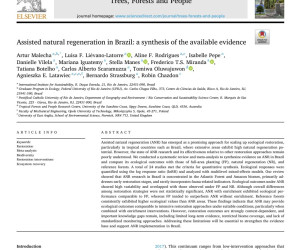
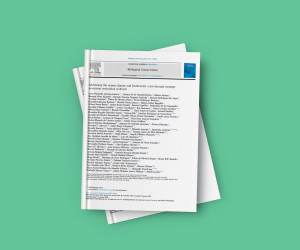
A new study by IIS researchers bringing together the available scientific evidence on Assisted Natural Regeneration (ANR) in Brazil and analysing its outcomes compared with other restoration strategies has just been published in the journal Trees, Forests and People.
The article, Assisted natural regeneration in Brazil: a synthesis of the available evidence, presents a systematic review and meta-analysis of research conducted in the country. A total of 24 studies were included in the quantitative analysis.
ANR combines natural vegetation recovery processes with interventions designed to overcome barriers to regeneration. Depending on the characteristics and needs of each area, these interventions may include fencing, invasive species control, nucleation techniques and enrichment planting.
The study compared ANR outcomes with those of full-area tree planting, unassisted natural regeneration and reference forests.
Overall, ANR achieved ecological outcomes similar to those of full-area tree planting, with no statistically significant differences. However, the analysis showed that ANR areas with enrichment planting achieved ecological performance comparable to full-area planting, while full-area planting tended to outperform ANR without enrichment.
The findings also indicate that ANR effectiveness depends on local conditions, land-use history and the interventions adopted. Reference forests showed higher ecological values than areas undergoing restoration, suggesting that biodiversity recovery and the restoration of ecosystem structure may require longer periods.
The research also identified significant gaps in the scientific literature. Most studies are concentrated in the Atlantic Forest and Amazon biomes, particularly in areas undergoing the early stages of restoration.
The authors highlight the need to expand long-term monitoring studies, improve the standardisation of assessment and monitoring methods, and generate further evidence on the costs, benefits and socioeconomic factors associated with ANR implementation.
By synthesising the available knowledge, the study contributes to understanding the contexts in which ANR can support the scaling up of restoration in Brazil. It also reinforces the importance of considering the ecological potential and specific characteristics of each landscape when selecting restoration interventions.
The research was conducted as part of the project Facilitating the Scaling Up of Assisted Natural Regeneration in Brazilian Ecosystems, funded by the Bezos Earth Fund.